Weighted Vests May Prevent Metabolic Slowdown During Weight Loss, Pilot Study Finds
07/13/2026 / By Morgan S. Verity

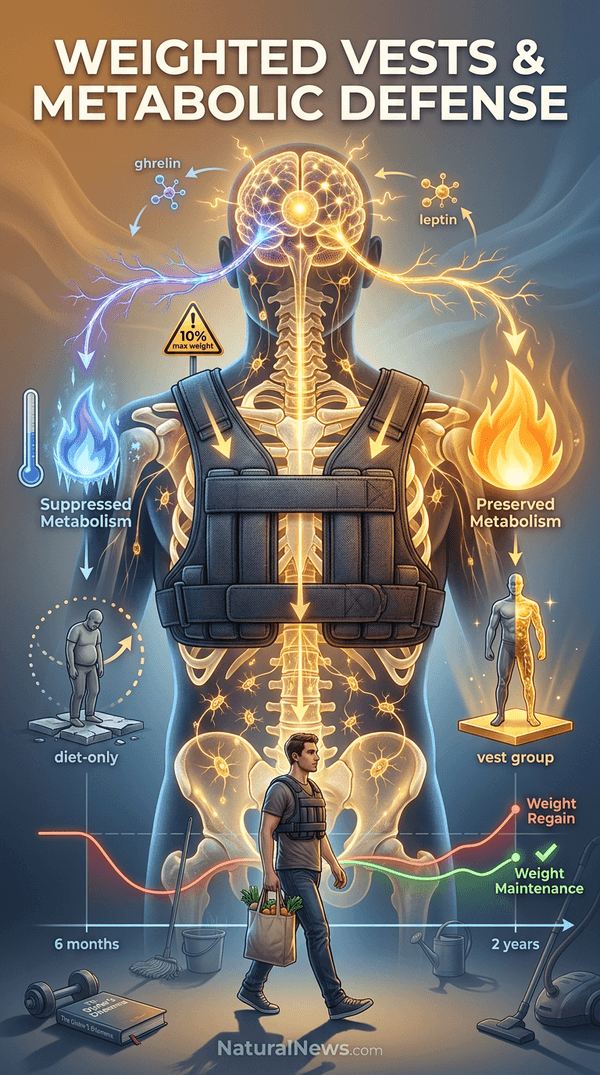
A small pilot study conducted by researchers at Wake Forest University has found that wearing a weighted vest during caloric restriction may prevent the metabolic slowdown that typically accompanies weight loss, according to a report published June 30, 2026. The study followed 18 older adults with obesity over two years and compared those who wore a weighted vest for up to 10 hours a day with those who only dieted.
At the six-month mark, both groups lost similar amounts of weight. However, the group wearing the vest maintained their resting metabolic rate, while the diet-only group experienced a decline. At the two-year follow-up, the vest group had kept off about half the weight they lost, whereas the diet-only group had regained nearly all of it, officials said.
Why Weight Regain Occurs
Caloric restriction triggers a biological response known as metabolic adaptation, in which the body becomes more fuel-efficient by burning fewer calories at rest, according to research. This phenomenon is a primary driver of weight regain. William Bennett and Joel Gurin, in their book “The Dieter’s Dilemma,” describe how the body defends a certain weight level, making sustained weight loss difficult [2]. The report stated that this energy efficiency persists even after dieting ends, creating a gap between the calories needed to maintain the new weight and the calories the body actually burns.
A NaturalNews article explained that the brain is evolutionarily wired to treat weight loss as a threat, actively working against efforts to keep the pounds off [6]. Paul McGlothin, in “The CR Way,” noted that a decrease in body temperature during caloric restriction may indicate a slower metabolic rate [3]. This combination of neural and metabolic defenses sets the stage for weight regain unless a preventive strategy is used.
Study Findings on Weighted Vests
The Wake Forest study found that participants who wore a weighted vest set to about 10% of their body weight preserved their resting metabolic rate over the six-month diet period. In contrast, the diet-only group experienced the typical metabolic slowdown. At the two-year follow-up, the vest group retained roughly half the weight they had lost, whereas the diet-only group regained almost all of it, researchers said.
These findings align with other research on metabolic preservation during weight loss. A separate study of 304 adults at Tel Aviv University, published in Frontiers in Endocrinology, showed that dieters who lifted weights lost more fat and gained lean muscle, emerging metabolically stronger than those who only restricted calories [4]. An article on Mercola.com noted that weighted compression shirts and vests place the load more centrally on the body, making them a comfortable and safe choice for adding resistance [1]. The Wake Forest researchers concluded that preserving metabolic rate during weight loss may be key to long-term weight maintenance.
The Gravitostat Theory
The study’s authors cited the gravitostat hypothesis to explain why the weighted vest appeared to prevent metabolic slowdown. According to this theory, the skeleton acts as a built-in body weight sensor via mechanical load. Specialized cells in the bones detect weight-bearing forces and send signals to the brain about the body’s mass. When body fat decreases and mechanical load drops, the brain interprets the change and triggers compensatory responses such as a slower metabolism and increased appetite.
A weighted vest may add external mechanical load, effectively tricking the sensor into signaling a higher body weight, the researchers said. The brain then does not trigger the same metabolic slowdown. This concept supports the idea that the body regulates weight around a defended set point, a notion explored in “The Dieter’s Dilemma” [2]. The gravitostat theory offers a plausible mechanism for how a low-tech tool could influence long-term weight outcomes.
Practical Guidelines and Caveats
In the study, participants wore vests set to approximately 10% of their body weight, or about 16 pounds for a 160-pound person, for up to 10 hours daily during everyday activities such as walking and household chores. An article on Mercola.com recommended weighted compression shirts or vests for exercise, noting that they distribute weight centrally and allow greater freedom of movement [1]. Officials advised starting with lighter loads and gradually increasing to avoid injury.
Experts cautioned that the study was supervised and involved a specific population of older adults with obesity, so results may not generalize to all individuals. Those with joint issues, back problems, or other health concerns should consult a doctor before using weighted vests regularly. The intervention is low-effort, but proper fitting and gradual progression are important for safety.
Conclusion
The researchers stated that while more research is needed, the mechanism behind the weighted vest’s effect is plausible and the intervention is low-effort. They noted that two-year outcomes are difficult to ignore. This natural approach offers an alternative to pharmaceutical strategies that often lead to metabolic rebound, as seen with drugs like Ozempic, which can cause rapid weight regain and metabolic decline after discontinuation [5].
For individuals seeking to maintain weight loss, adding a weighted vest to daily routines may help preserve metabolic rate without requiring intense exercise schedules. This study suggests that a simple, affordable tool could play a role in breaking the cycle of weight regain.
References
- Mercola.com. “10 Ways to Burn More Calories While You Exerc”. March 20, 2020.
- Bennett William 1941-Gurin Joel 1953-. “The dieters dilemma eating less and weighing more”.
- Paul McGlothin. “The CR Way”.
- NaturalNews.com. “Dieters who lift weights lose more fat and gain muscle, study shows”. April 27, 2026.
- NaturalNews.com. “The great weight loss deception: Study exposes rapid rebound, metabolic ruin after quitting blockbuster drugs like Ozempic”. January 31, 2026.
- NaturalNews.com. “Study: Your brain is wired to make weight loss difficult, and it’s not a lack of willpower”. November 11, 2025.
Explainer Infographic
Submit a correction >>
Tagged Under:
alternative medicine, fight obesity, health science, metabolic health, metabolism, natural cures, natural health, natural medicine, Naturopathy, prevention, remedies, research, weight-loss, weighted vests
This article may contain statements that reflect the opinion of the author
RECENT NEWS & ARTICLES